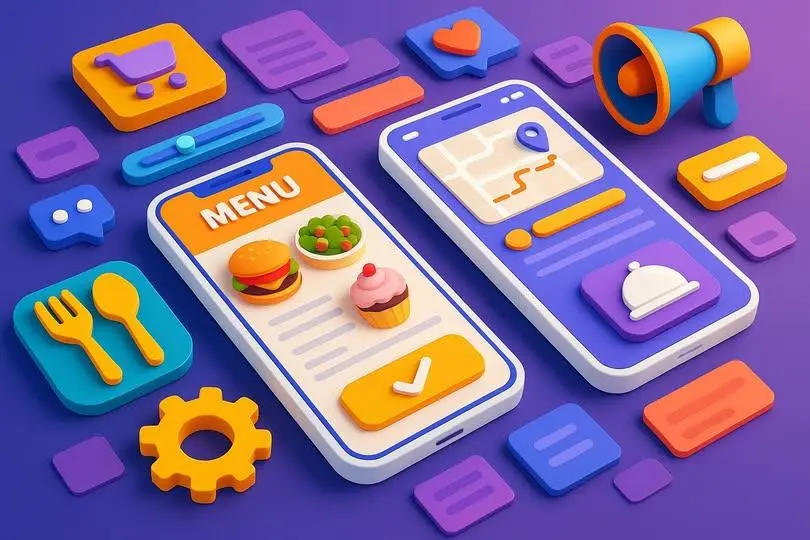
Mobile app development for restaurants
Restaurants today face fierce competition, and diners expect frictionless digital experiences. A mobile app tailored to your establishment bridges the gap between on-premise dining and off-premise convenience. Through strategic restaurant ordering app development for iOS and Android, you can offer contactless menus, table reservations, loyalty rewards, and more — all under your brand’s roof rather than a third-party platform’s. Key benefits include:- Brand control: Your app showcases your menu, ambiance, and special offers without dilution.
- Direct engagement: Push notifications and in-app promotions foster repeat visits.
- Data ownership: Collect first-party customer data for personalized marketing and menu optimization.
- Revenue growth: Commissions on third-party platforms can exceed 20%; a direct app minimizes these fees.
- Streamlined Ordering & Payments
- With features like a mobile ordering app with contactless payment for cafés, diners can browse menus, customize dishes, and check out within seconds. Integrated secure payment gateway integration in restaurant apps ensures compliance with PCI DSS standards, safeguarding both you and your guests.
- Enhanced Customer Loyalty
- Gamify your rewards through loyalty rewards and gamification restaurant app integrations. Offer points, badges, and tiered benefits that keep diners engaged. White-label solutions allow you to maintain consistent branding across loyalty programs without hefty development overhead.
- Improved Operational Efficiency
- Apps with analytics dashboards in restaurant mobile apps provide real-time insights into top-selling items, peak ordering times, and customer demographics. This data informs staffing, inventory, and menu design decisions, driving profitability.
- Seamless Reservations & Curbside Pickup
- Integrate a table reservation mobile app for fine dining and a mobile app for curbside pickup and pre-ordering to handle busy periods gracefully. Automated notifications and order tracking reduce no-shows and ensure timely service.
- Broader Reach & Personalization
- Leverage geo-targeted restaurant promotions via mobile app to send location-based deals. Multi-language support caters to diverse clientele through multi-language restaurant mobile app development, enhancing accessibility and inclusivity.
Key features of restaurant mobile apps
A successful restaurant app balances user-friendly design with advanced functionalities. Below is a comprehensive feature set drawn from industry best practices:- Custom mobile app development for restaurants: Tailored UI/UX reflecting your brand identity.
- Restaurant ordering app development for iOS and Android: Native or cross-platform reach.
- White-label restaurant loyalty app solutions: Quick deployment with your branding.
- Food delivery integration app for restaurants: Seamless order routing to in-house or third-party delivery.
- Table reservation mobile app for fine dining: Real-time availability and guest preferences.
- Mobile ordering app with contactless payment for cafés: QR code and NFC payment options.
- Cloud-based restaurant app development services: Scalable back-end infrastructure.
- App development for restaurant menu digitalization: Interactive, multimedia menus.
- Multi-language restaurant mobile app development: Support for Urdu, English, and regional languages.
- Push notification marketing for restaurant apps: Scheduled and triggered notifications.
- Mobile app with real-time order tracking for restaurants: Order status updates from kitchen to doorstep.
- Subscription-based ordering app for meal prep services: Recurring orders for loyal customers.
- Restaurant app with CRM and customer feedback: Built-in review collection and management.
- QR code menu and ordering app development: Frictionless dine-in experiences.
- Geo-targeted restaurant promotions via mobile app: Location-based specials.
- Offline-capable restaurant app for low connectivity areas: Cached menus and orders.
- Mobile app development for franchise restaurant chains: Centralized management with localized branches.
- AI-powered recommendation engine in restaurant apps: Suggest dishes based on preferences.
- Loyalty rewards and gamification restaurant app: Points, badges, and challenges.
- API integration for POS and mobile restaurant app: Real-time sync with existing systems.
- Mobile app for curbside pickup and pre-ordering: Fast, contactless service.
- Analytics dashboard in restaurant mobile apps: KPI tracking and reporting.
- Mobile app development for ghost kitchens: Virtual brand management.
- Secure payment gateway integration in restaurant apps: PCI-compliant checkout.
- Cross-platform restaurant mobile app development: Single codebase for iOS & Android.
- Mobile app for customer review and retention in restaurants: In-app feedback loops.
- Personalized menu suggestions app for restaurants: AI-driven upsells.
- Restaurant mobile app with social sharing features: User-generated content and referrals.
- Subscription meal plan mobile app for healthy eateries: Weekly or monthly meal packages.
Choosing the right development approach: native vs cross-platform
One of the earliest decisions in mobile app development for restaurants is your technology stack. The two primary pathways are:- Native Development
- Built with Swift (iOS) and Kotlin/Java (Android).
- Optimal performance and access to device-specific APIs.
- Higher development and maintenance costs due to separate codebases.
- Cross-Platform Development
- Frameworks like React Native or Flutter allow a single codebase for both platforms.
- Faster time-to-market and reduced development budget.
- Slight trade-offs in performance and access to new native features.
- Simplicity is key: Limit steps to browse, select, and order.
- Consistent branding: Use your logo, color palette, and imagery throughout the app.
- High-quality visuals: Showcase dishes with professional photography and rich descriptions.
- Accessible navigation: Ensure menus and filters are reachable in two taps or fewer.
- Responsive layouts: Adapt seamlessly to both phones and tablets used by hosts or servers.
- Offline-capable interfaces: Allow diners to view menus even with spotty connectivity.
- Multi-language support: Cater to diverse audiences with easy language switching.
- Clear CTAs: Buttons like Order Now, Reserve Table, and Redeem Rewards should stand out.
Integrations and technology stack for restaurant apps
Robust back-end and third-party integrations ensure your app functions seamlessly:- POS & ERP Integration
- Synchronize menu items, pricing, and inventory in real time via API integration for POS and mobile restaurant app.
- Automate order routing and payment reconciliation.
- Payment Gateways
- Embed secure payment gateway integration in restaurant apps such as Stripe, PayFast, or local providers.
- Support multiple methods: credit cards, mobile wallets, and cash-on-delivery options.
- CRM & Feedback Modules
- Build a restaurant app with CRM and customer feedback to collect reviews, ratings, and preferences.
- Trigger loyalty campaigns based on spending habits.
- Analytics & Reporting
- Implement an analytics dashboard in restaurant mobile apps to monitor key metrics: DAUs, AOV, retention rates, and churn.
- Leverage data for menu engineering and targeted promotions.
- Advanced Technologies
- An AI-powered recommendation engine in restaurant apps for personalized upsells.
- Chatbot integrations for 24/7 support.
- Geofencing for geo-targeted restaurant promotions via mobile app.
Development process: from idea to launch
A structured workflow ensures timely, budget-friendly delivery:- Discovery & Planning
- Define objectives, user personas, and feature sets.
- Draft wireframes and technical specifications.
- Design & Prototyping
- Produce high-fidelity mockups and interactive prototypes.
- Validate with focus groups or loyal patrons.
- Development & Testing
- Implement features in sprints, prioritizing core flows like ordering and payments.
- Perform unit, integration, and usability testing.
- Deployment & Launch
- Publish to Apple App Store and Google Play Store with optimized descriptions and screenshots.
- Configure app analytics and monitor crash reports.
- Post-Launch Support
- Release regular updates, security patches, and feature enhancements.
- Gather user feedback for continuous improvement.
- App Store Optimization (ASO):
- Target keywords like “restaurant ordering app” and “local food delivery.”
- Optimize icons, screenshots, and descriptions for higher conversion.
- Push Notification Campaigns:
- Use push notification marketing for restaurant apps to announce flash deals or loyalty rewards.
- Balance frequency to avoid user fatigue.
- Geo-targeted Promotions:
- Leverage geo-targeted restaurant promotions via mobile app to attract passersby with real-time offers.
- Social Media & Influencers:
- Showcase exclusive in-app offers on Instagram and Facebook.
- Encourage user-generated content through a restaurant mobile app with social sharing features.
- Referral Programs:
- Incentivize diners to invite friends via discounts or bonus points.
- Subscription Models:
- For meal-prep or healthy eateries, implement a subscription meal plan mobile app for recurring revenue.
Maintenance and scaling considerations
Long-term success hinges on proactive maintenance and strategic growth:- Regular Updates:
- Keep pace with OS upgrades and security patches.
- Introduce new features, such as AI-powered recommendation engine enhancements.
- Performance Monitoring:
- Monitor load times, crash rates, and error logs.
- Scale infrastructure using cloud auto-scaling.
- Offline Functionality:
- For remote areas, ensure an offline-capable restaurant app for regions with low connectivity that caches menus and orders.
- Expanding Geographies:
- Localize with multi-currency and multi-language restaurant mobile app development.
- Adapt compliance measures for different regions.
- Ghost Kitchens & Virtual Brands:
- Launch new concepts quickly with mobile app development for ghost kitchens, driving incremental revenue.
Case studies: real-world success stories
- UrbanBites Café (Lahore):
- Implemented a QR code menu and ordering app development solution that reduced order errors by 35%.
- Introduced a loyalty rewards and gamification restaurant app, boosting repeat visits by 42% within three months.
- SpiceRoute Chain (Karachi):
- Rolled out a mobile app for curbside pickup and pre-ordering across 12 locations.
- Integrated analytics dashboard in restaurant mobile apps to refine menu offerings, increasing average order value by 18%.
- GreenEats Meal Prep (Islamabad):
- Launched a subscription-based ordering app for meal prep services, attracting 500+ monthly subscribers.
- Leveraged an AI-powered recommendation engine for personalized meal plans, driving a 25% lift in upsells.

